
 |
|
| Main > A Short History of the Herring Fishery | |
A Short History of the Herring Fishery CBC News Online | Nov. 23, 2004 |
|||
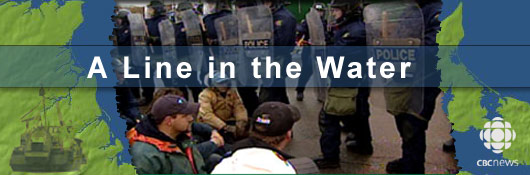
In every food chain something has to be at the bottom, and in Atlantic Canada's commercial fishery herring is close. At the same time, this little fish has carved out more than its share of headlines over the last year. Herring is at the centre of dispute that's seen tense confrontations between police and P.E.I. fishermen. And it is at the heart of meetings at the highest levels of the Department of Fisheries and Oceans. The herring fishery in the Atlantic Canada went on for 25 years without a single incident. Inshore fishermen, those with the tiny fishing boats you see tied to the dock, fished the herring. And in deeper water, larger seiners cast their bigger purse-style nets for the herring.
It's the area herring seiners and inshore fishermen call home too. The crewmembers live in the small communities that hug the shoreline. They spend their money in places like Caraquet. And perhaps the most important factor — the herring fishery gives close to 1,000 people working in the fish plants and on the seiners in northern N.B. the weeks they need to qualify for employment insurance. Change in the fishery Until four years ago, the herring seiners caught the yearly quota allotted by DFO in the Bay of Chaleur. In 2000, the inshore fishermen became concerned about what the seiners might be doing to the stocks of herring in the bay. They decided to do something about it. The fishermen protested, they went out on the water and harassed the seiners, they bent the ears of federal and provincial politicians; they got what they wanted. DFO decided the seiners would only be allowed to catch 50 per cent of the yearly quota in the Bay of Chaleur. Herring are a bit like salmon —albeit without the majestic look or storied legend of the river fish. Like salmon, herring head back to the waters where they were hatched to spawn. It is one of the only migratory species of fish in the commercial fishery. Every fall, schools of herring are on the move in the waters of Atlantic Canada, and when they run into their own they stick together, becoming a larger group. By winter they're in the deep ocean water off Cape Breton and Newfoundland where they can survive the winter. Then, in spring, they head back to the waters they left in the fall. It means most bays in the region have a local herring stock. With a need now to fill half of their quota away from home —out of the Bay Chaleur — the seiners follow the herring. And in the last four years, that's brought them closer to P.E.I. Shares of catch not an issue The inshore fishermen in the region are given the bulk of the Gulf of St. Lawrence herring quota, 75 per cent of it. This isn’t a dispute over who gets to catch what in a diminishing
stock. In 2004 the federal government added 11,000 tonnes to the total quota of herring. This year 73,000 tonnes are up for grabs. At times the herring fishery has been lucrative; however, most years are like 2004, herring is worth eight cents a pound. It's a far cry from the early 1960s when 65 seiners were fishing in Atlantic Canada. The herring fishery nearly collapsed in the early 1970s. Fisheries and Oceans stepped in and put most of the seiners out of business. This year six herring seiners are fishing in the Gulf and another five are operating in Newfoundland and Labrador. The federal department says it manages the fishery well by controlling where the seiners can work, and how much they can scoop from the ocean with their purse-style seine nets. Those scientists do say if the nets are not set properly they can drag on the bottom of the ocean floor. Still, it says the fishery is viable and will continue to be with this sound commercial species. Tension on the wharf Then why the riot squad have to clear fishermen from the wharf on P.E.I. last November? It is because herring play an important role in life under the sea. They are used as bait in the most lucrative fishery in the Island economy; lobster. And it is food for the bluefin tuna, another of the big money fisheries on P.E.I. Lobster also eat the herring that die and fall to the ocean floor.
The Island fishermen are worried about what will happen if the herring disappear from the local waters. They want to know how many of the fish the seiners catch near P.E.I. are part of the local stock. There's also concern about what the nets used by the seiners do as they skim along the water above the area where lobster spawn and live. The province also wants to know why the seiners are allowed to fish shallower water than in the past. In the 80s, the seiners had to stay in water that was at least 25 fathoms deep. That's 150 feet from the surface to the ocean floor. After an error was made translating some documents the rules were changed and the seiners were allowed to fish in water 17 fathoms deep. The seiners didn't always fish that close to shore. However, when herring prices are low, and the margins of profit are squeezed, the boats do what they can to catch the herring quickly and be close to an area where they can unload onto tractor-trailers. Souris P.E.I., with its federal wharf open to all vessels, offers the right combination for the seiner fleet. The department maintains the limited research it has available indicates there's no reason to worry. Federal Fisheries Minister Geoff Regan made an attempt to appease the Island fishermen earlier this fall. He made changes to the management plan, moving the seiners into water into 20 fathoms of water, and saying the zone between 17 and 20 fathoms would be used for a scientific fishery. It's now known that the scientific fishery will allow the seiners to catch 15 per cent of their quota in that zone. An area the island fishermen maintain is too sensitive to their future. After a year of talking, nothing seems to have changed. The seiners
have a right to fish, and they plan to.
|
|||
| ^ Top of page |
 For
most of the last three decades, the heart of the herring fishery
has been on the Acadian Peninsula of New Brunswick. There's
a body of water called the Bay of Chaleur along the northern
coast of the province, and the herring like living there.
For
most of the last three decades, the heart of the herring fishery
has been on the Acadian Peninsula of New Brunswick. There's
a body of water called the Bay of Chaleur along the northern
coast of the province, and the herring like living there.  CBC does not endorse and is not responsible for the
content of external sites. External links will open
in a new window.)
CBC does not endorse and is not responsible for the
content of external sites. External links will open
in a new window.)
|


DFO's 2004 herring management plan Allister
Surette's report on the conflict (1 MB) Value of marine fisheries - Government of P.E.I. The Maritime Fishermen's Union Atlantic Herring - Gulf of Maine Aquarium Oceans Act - Government of Canada ( |


From CBC P.E.I. Oct. 22, 2004: Nancy Russellvisits northern N.B. to learn why the herring seiners work is so important. Oct. 25, 2004: Nancy Russell shares the concerns N.B. residents had with the herring seiners. (runs 7:13) |



|
Disclaimer: The CBC reserves the right to edit submissions. Participants acknowledge that the CBC has the right to reproduce, broadcast and publicize their comments or any part thereof in any manner whatsoever. We will post as many submissions as possible but can not guarantee that every contribution will be published. |
 Send us your comments